


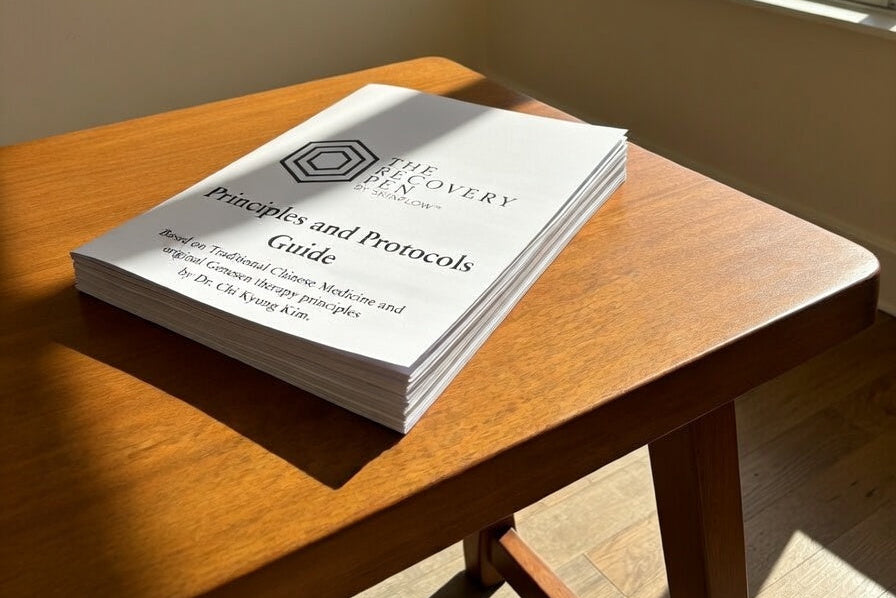
Protocols Guide
TCM principles & 85+ point-specific techniques
Head-to-Toe Recovery
Six ways the pen helps you feel & live better.



Targeted relief from aches, pains, and discomfort—anywhere, anytime.
Whether you're dealing with joint stiffness, muscle soreness, inflammation, or everyday tension, the Recovery Pen provides targeted relief in just 3–7 minutes. No batteries, no pills—just a simple, non-invasive way to help ease discomfort.
Explore targeted protocols for some of the most common areas of pain, stiffness, soreness, and tension.
The Recovery Pen can also be used on specific meridian and acupressure points for a wide range of applications.
Release tight, tender, and sensitive areas across the neck, shoulders, upper back, and chest.
Relieve aches, stiffness, and tension throughout the lower back, quadratus lumborum (QL), hips, and surrounding pelvis.
Ease headaches and head tension with targeted local and meridian-based applications across the head, neck, jaw, and surrounding tissues.
Tip: Also explore key acupoints at the base of the skull (GB20) and in the webbing between the thumb and index finger (LI4).
Ease pain and soreness around the knee while supporting smoother, more comfortable movement.
Open restricted areas throughout the hips, glutes, and surrounding pelvis to improve comfort and mobility.
Relieve restriction, ease aches, and restore fluid movement through the hands, wrists, and forearms.
Ease soreness and discomfort, support healthy blood flow, and restore more comfortable movement through the feet and ankles.
Releases trigger points and fascial restrictions to improve range of motion and restore freedom of movement.
The body's fascia forms an interconnected network that influences mobility, posture, and how efficiently force moves through the body. The Recovery Pen provides targeted myofascial and trigger point support to help improve tissue responsiveness and elasticity, supporting freer, more fluid movement.
Fascia also plays an important role in proprioception—the nervous system's awareness of body position and movement. The Recovery Pen's four modalities provide targeted sensory input to the nervous system while simultaneously helping release fascial adhesions and restrictions.
Explore areas of tightness, restriction, stiffness, or limited movement, then reassess range of motion and symmetry as the tissue begins to respond.
Apply medium-firm pressure at approximately a 90° angle. Begin by moving the area you want to work on and notice where you feel restriction, stiffness, reduced range of motion, or asymmetry from one side of the body to the other.
Spend approximately 3–7 minutes per priority area, or until you notice a meaningful change in movement or tissue sensitivity.
Adapt as needed: Use this as a starting point. Over time, focus more on the areas that consistently feel restricted or create the greatest improvement in mobility, and spend less time on areas that don't seem as relevant.
Encourages calm by supporting nervous system balance, vagus nerve pathways, and the body's natural rhythm of rest and sleep.
Within just a few minutes, the Recovery Pen can become part of a simple routine for calming the body and releasing everyday tension. Use it across key areas associated with nervous system regulation—including the jaw, neck, chest, and upper abdomen—to support relaxation, easier breathing, and a smoother transition into rest or sleep.
Promote relaxation, release accumulated tension, and support nervous system balance with a simple head-to-body calming sequence.
Total time: approximately 8–10 minutes.
Apply moderate pressure at approximately a 90° angle. Move slowly and explore each area, looking for spots that feel tender, tight, sensitive, or especially responsive. Pause for 10–45 seconds on those areas before moving on.
Reassess: Return to areas that felt especially tender, intense, or responsive and notice how they've changed. Pay attention to your breathing, muscle tension, and overall sense of calm.
Adapt as needed: This sequence is a starting point. Over time, focus more on the areas that feel most responsive or produce the greatest sense of release or calm, and spend less time on areas that don't seem as relevant.


Prepare the body, support endurance, and accelerate recovery before, during, and after activity.
Performance starts before activity. The Recovery Pen helps warm connective tissue and release tight fascia to improve range of motion and movement readiness. During activity, it supports blood flow to help maintain fluidity and endurance. Afterward, it accelerates recovery so you can train harder, sooner.
Battery-free, cordless, and always ready, the Recovery Pen is easy to keep in your pocket or gym bag and use before, during, or after activity—often in just a few minutes.
Enhance performance before activity, maintain mobility and muscle readiness during training, and accelerate recovery afterward.
Adapt as needed: Every activity and every body is different. Use this as a starting point, then focus more time on the muscles and areas that respond most noticeably for you before, during, and after activity.
Apply medium-firm pressure at approximately a 90° angle. Explore the muscles, joints, and surrounding connective tissue that will be most involved in your activity, looking for areas that feel tight, tender, restricted, or especially responsive.
Pause for 10–45 seconds on those areas and continue exploring until the tissue begins to feel less sensitive or movement feels easier. Recheck your range of motion before starting.
Spend approximately 3–7 minutes on the areas that need the most attention.
Between sets, exercises, drills, holes, intervals, or periods of activity, return to the muscles and surrounding tissue doing the most work.
Explore areas that begin to feel tight, fatigued, heavy, or restricted. Use medium-firm pressure and pause briefly on responsive spots to help maintain blood flow, fluidity, and movement quality before returning to activity.
Use the pen for approximately 30–60 seconds between sets or exercises as needed.
Afterward, explore the muscles and surrounding tissue that received the most workload, especially areas that feel sore, tight, tender, or restricted.
Move slowly through each area, pausing for 10–45 seconds on the most responsive spots. Spend additional time where the pen feels more intense to touch or where you notice the greatest sense of release.
Reassess soreness, tension, and range of motion, then return to any areas that still need attention.
Spend approximately 3–7 minutes per priority area as needed.
Go beyond local relief: restore balance with dozens of meridian-based protocols rooted in East Asian medicine.
Traditional East Asian medicine has used precise point stimulation along meridian pathways for thousands of years. The Recovery Pen marries that time-tested framework with modern technology, focusing far-infrared energy, magnetic field therapy, and negative ion emissions through a precision 24K gold acupressure tip.
Rather than choosing between Eastern and Western approaches, the pen is designed to bridge both: traditional East Asian concepts of Qi, meridians, and energetic flow alongside modern understanding of fascia, circulation, nervous-system signaling, and tissue physiology.
Dr. Kim's original meridian-based framework was developed in Korea more than 30 years ago and has since been used by over 800,000 people. His Principles & Protocols Guide includes 85+ protocols spanning areas such as musculoskeletal, skin, circulatory, immune, respiratory, nervous-system, digestive, urinary, and metabolic support.
Learn more about Dr. Kim and the origins of the Recovery Pen
TCM principles & 85+ point-specific techniques
Support the systems that drive energy, resilience, recovery, and lasting vitality.
Longevity is not achieved by optimizing just one system. It depends on the body's interconnected systems maintaining flow, generating energy, recovering, regulating, moving, and adapting over time.
The Recovery Pen's four complementary therapies, delivered through targeted point application, support the body across multiple systems—including circulation and cardiovascular function, nervous system and vagus nerve regulation, musculoskeletal and fascial health, digestive and metabolic function, lymphatic and immune resilience, and cellular energy and polarity balance.
Physical performance and recovery are major components of healthy aging. Supporting movement readiness, circulation, endurance, tissue recovery, and the ability to train consistently can all contribute to aging well.
The Recovery Pen fits into virtually any recovery or biohacking routine. Its four modalities stack seamlessly with other therapies—whether you're inside a hyperbaric chamber or infrared sauna, using a red light or near-infrared panel, or lying on a PEMF or far-infrared mat—and with no battery or cord, there's no charging or downtime.
Other devices target one modality. The Recovery Pen delivers all four.
| Device | Far infrared | Magnetic field | Negative ions | Acupressure |
|---|---|---|---|---|
|
Recovery Pen Battery-free, handheld | Pinpoint delivery | 3,200 Gauss | Pinpoint delivery | Gold-tipped |
|
FIR saunas, mats & panels Radiant heat, stationary | Whole-body | — | — | — |
|
Red light devices Visible light, not far infrared | Not FIR | — | — | — |
|
Magnetic devices Bracelets & wraps, low strength | — | Low Gauss | — | — |
|
PEMF devices Pulsed field, requires power | — | Pulsed, low Gauss | — | — |
|
Air ionizers Ambient, not body-directed | — | — | Dispersed | — |
|
Grounding & ion mats Passive contact, stationary | — | — | Whole-body | — |
|
Acupressure tools Mechanical pressure only | — | — | — | Standard |
Reduces pain & inflammation, releases fascia & restores mobility.
Enhances microcirculation & oxygenation for cellular repair.
Supports nervous system balance & neutralizes free radicals.
Focuses and amplifies all modalities through a 24K gold tip.

Try the Recovery Pen for 60 days. If it's not right for you, send it back for a full refund.